Bench · mock circulation loop
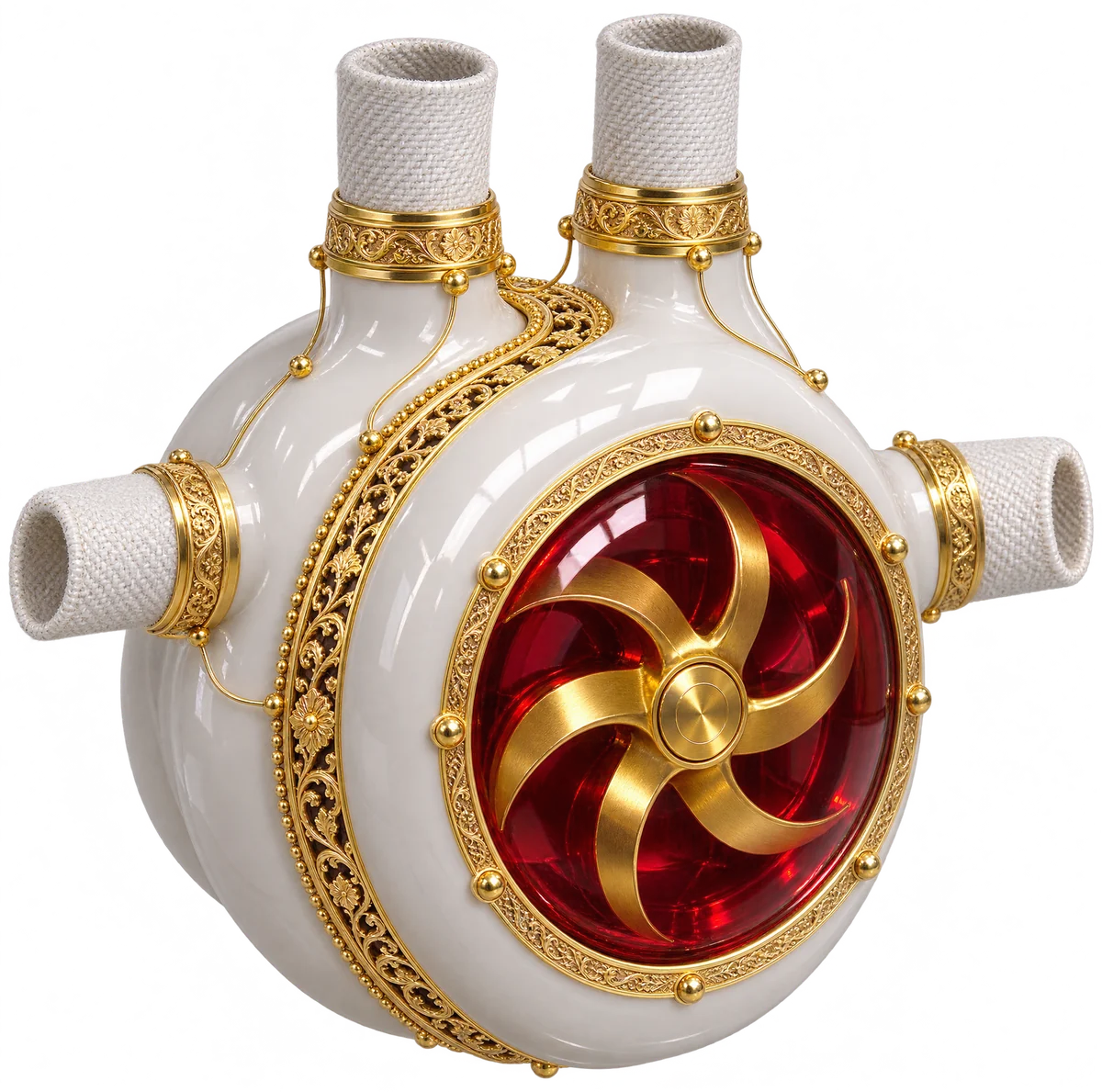
Cor Total artificial heart
One moving part replaces both ventricles.
A heart beats about 100,000 times a day. At rest it moves 5 litres of blood a minute, and more than 20 in hard exercise. Pumps that copy the beat rely on flexing membranes and valves, and those fatigue.
Cor does not beat. A single titanium rotor floats in a magnetic field and spins between two chambers. Vanes on one face send blood to the lungs. Vanes on the other send it to the body. Nothing touches the rotor, so there are no bearings to wear and no valves to stick. The layout follows the rotary total artificial heart described by Timms and colleagues, first implanted in a person in July 2024.
Blood sets the limits. Red cells rupture when shear stress passes roughly 150 pascals. Magnetic levitation allows wide gaps around the rotor, which keeps shear low and washes every surface with fresh blood.
- Mass
- 300 g
- Beats a day
- 100,000
- Output at rest
- 5 L/min
| Property | Native heart | Cor design target |
|---|---|---|
| Output | 5 L/min at rest, over 20 in hard exercise | 3 to 12 L/min, continuous |
| Moving parts | Two ventricles, four valves | One levitated rotor, no valves |
| Left–right balance | Frank–Starling law | Rotor shifts along its axis |
| Pulse | About 100,000 beats a day | None by default; speed can be modulated |